Choosing a laminate wall panel supplier is not only a price comparison. It is a decision about surface durability, installation details, and how a finish will look under real lighting. Architect Frank Lloyd Wright’s principle, “Form and function should be one,” offers a useful design lens, though it is not a product-specific recommendation. In practice, a warm woodgrain panel can look convincing in a showroom yet appear flat beside a north-facing window. Small details matter.
This guide to China’s top 10 suppliers of Laminate Wall Panels is designed to help buyers compare more than catalog images. It considers product range, finish consistency, customization, sample availability, communication, and export experience. Ask suppliers for technical data and physical samples. Check edge details, surface texture, color variation, and cleaning guidance. A glossy panel may brighten a narrow corridor, but it can also reveal fingerprints and uneven wall surfaces. There is no perfect finish.
Supplier claims deserve careful review. Confirm specifications directly, and request clear answers about lead times, packaging, and quality checks. A polished website is not proof of stable production. Nor does a low quote guarantee lower project costs. Freight, installation requirements, and replacement availability can change the calculation. This comparison provides a starting point, not a substitute for sample testing or project-specific checks. Some information may need confirmation with each supplier; that is worth doing before committing.
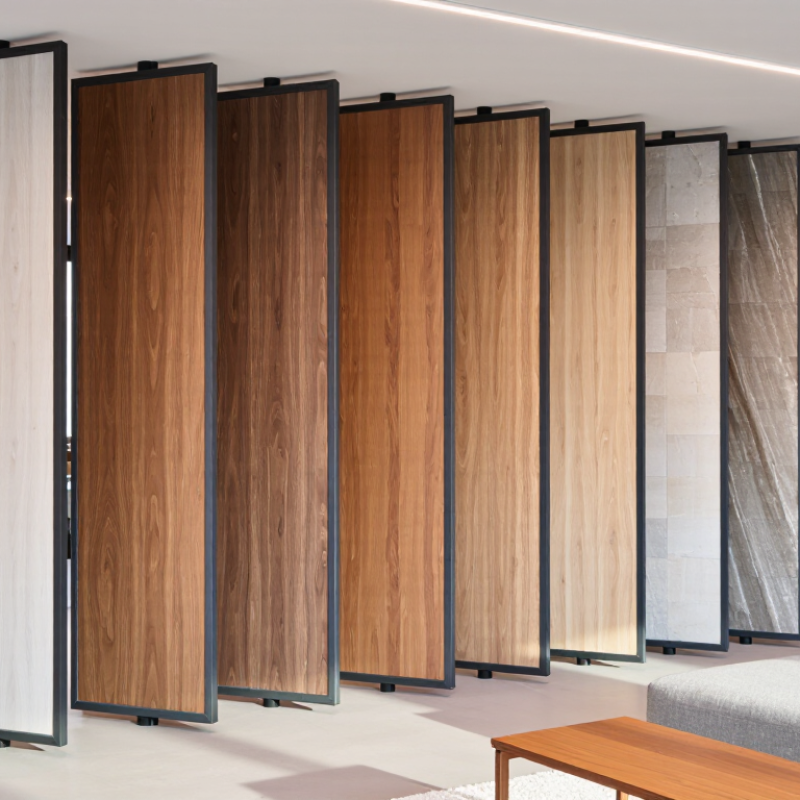
Laminate wall panels are engineered boards with a decorative, durable surface bonded to a supporting core. The core is often medium-density fiberboard, plywood, or particleboard. The surface may resemble oak grain, pale stone, or a smooth solid color. It is usually a printed decorative layer protected by resin. High-pressure laminate can include several resin-treated kraft paper layers beneath the décor, while other panels use a thinner melamine surface. The term “laminate panel” is not perfectly precise; suppliers may use it for different constructions. Details matter.
Manufacturing starts with preparing the core to a consistent thickness. The decorative layer and protective surface are then bonded to it, often using heat and pressure. After cooling, panels are trimmed, and exposed edges may be sealed or finished with matching strips. Quality checks can include surface inspection, thickness measurement, and testing the bond between layers. A small edge defect can let moisture reach the core, so edge treatment is worth checking. It varies. One limitation is that a convincing wood pattern does not make the panel real timber, and damage to the surface can be difficult to repair invisibly. Comparing the core, surface thickness, and intended room conditions gives buyers more useful information than appearance alone.

China Top 10 Laminate Wall Panel Suppliers
How China’s Laminate Wall Panel Industry Is Structured
China’s laminate wall panel industry is a supply chain, not a single factory category. Upstream producers supply substrates, decorative films, resins, and surface treatments. Panel manufacturers combine these inputs through lamination, pressing, trimming, and finishing. Some factories control most steps; others buy semi-finished boards and focus on customization.
The supplier landscape includes large-volume manufacturers, specialist workshops, trading companies, and export-oriented sales teams. Their roles can overlap. A factory may make panels but outsource profiles, packaging, or laboratory testing. Buyers should ask who produces each component and where final inspection happens. A sample can look convincing under showroom lights. Check it in ordinary daylight, too.
Specifications often separate a reliable supplier from a convenient one. Confirm panel thickness, substrate type, surface texture, edge treatment, and moisture-related test conditions. Request current test reports and compare them with the exact product being quoted. This is practical, not glamorous. Production capacity also needs context: a large monthly figure may describe several product lines, not your chosen design. Lead times depend on material availability, finish changes, and packing requirements. Even careful suppliers can misjudge these details, so clear written specifications and a pre-shipment check remain useful.
Industry structure overview: the entries below describe ten common supplier segments, not a ranked list of named companies. Products, capabilities, and certifications vary by manufacturer and should be verified for each order.
| No. | Supplier segment | Typical panel types | Common materials and processes | Typical buyers and applications | What to verify when sourcing |
|---|---|---|---|---|---|
| 1 | High-pressure laminate (HPL) panel manufacturers | HPL-faced wall panels and decorative laminate sheets | Decorative paper and resin pressed under heat and pressure; panels may be bonded to a substrate. | Commercial interiors, education, healthcare, offices, and public buildings | Wear, stain, fire and emissions test reports; substrate specification; edge and installation details |
| 2 | Compact laminate producers | Self-supporting compact laminate panels and cubicle or wall cladding panels | Multiple resin-impregnated paper layers consolidated into a dense laminate sheet | Wet-area partitions, washrooms, laboratories, and high-traffic interiors | Panel thickness, flatness, moisture-related performance, fixing method, and applicable test standards |
| 3 | PVC decorative panel manufacturers | Hollow-core, solid-core, and printed or laminated PVC wall panels | Extruded PVC profiles, often finished with a printed film or surface coating | Residential renovations, ceilings, and interior wall finishes | PVC formulation, dimensions, flame-performance documentation, surface durability, and installation accessories |
| 4 | WPC wall-panel manufacturers | Wood-plastic composite (WPC) cladding, fluted panels, and decorative profiles | Thermoplastic resin combined with wood flour or other plant-based fillers; commonly produced by extrusion | Interior feature walls and, where specifically rated, selected exterior applications | Indoor or outdoor suitability, formulation, UV and moisture test data, expansion allowance, and fire classification |
| 5 | SPC and mineral-core panel manufacturers | Rigid-core decorative wall panels and coordinated floor-and-wall collections | Rigid mineral-and-polymer composite core with a decorative film and protective wear layer | Residential and light-commercial interior renovations | Confirm the product is designed for wall use; check core composition, fire data, joint system, and fixing instructions |
| 6 | Melamine-faced board and panel suppliers | Decorative panels based on particleboard, MDF, or other engineered wood substrates | Decorative paper impregnated with resin and bonded to a wood-based board under heat and pressure | Furniture, cabinetry, fitted interiors, and dry-area wall applications | Board grade, formaldehyde-emissions documentation, moisture suitability, thickness, and edge treatment |
| 7 | Decorative film and surface-lamination specialists | Film-faced panels, synchronized finishes, and custom decorative surfaces | Printed PVC, PET, PP, or paper-based surface materials laminated onto suitable panel substrates | Panel assemblers, interior-product factories, and project-specific finish programs | Film composition, adhesive system, color consistency, scratch resistance, and substrate compatibility |
| 8 | Engineered-wood and veneer panel manufacturers | MDF or plywood panels with laminate, veneer, or decorative paper finishes | Wood-based substrates finished by pressing, laminating, or veneer bonding | Residential interiors, furniture, joinery, and custom wall features | Substrate grade, veneer or finish specification, emissions documents, moisture conditions, and machining tolerances |
| 9 | Integrated wall-system fabricators | Pre-finished panels, trims, corner pieces, and coordinated installation systems | May combine sourced boards or laminates with cutting, edge finishing, profiling, and accessory fabrication | Contractors, fit-out companies, distributors, and project buyers | Factory scope, drawing control, installation guidance, packaging, replacement-part availability, and project references |
| 10 | Export-oriented OEM and contract manufacturers | Customer-specified laminate, PVC, WPC, or engineered-board wall panels | Manufacturing or assembly to buyer specifications; materials and processes depend on the order | Importers, private-label programs, and overseas project supply chains | Audit production capability, sample-to-order consistency, inspection plan, export packaging, and destination-market compliance |
Industry structure at a glance: the supply chain commonly includes raw-material and decorative-surface producers, panel manufacturers, downstream fabricators, and export or distribution partners. Manufacturing clusters and capabilities vary by product category; confirm the actual factory location, production scope, and current certifications directly with each prospective supplier.
When evaluating Chinese laminate wall panel suppliers, ask for test reports tied to the exact panel construction—not a similar product. Check thickness, surface wear, moisture response, dimensional stability, and edge finish.
For interior panels, verify formaldehyde results against GB 18580-2017; its E1 limit is 0.124 mg/m³ under the specified chamber test. The number alone is not enough. Confirm the report identifies the substrate, adhesive, and finish you plan to order.
Environmental claims also need evidence. The World Green Building Council’s 2019 report, Bringing Embodied Carbon Upfront, attributes about 11% of global carbon emissions to building materials and construction. This figure is not a panel rating, but it makes material sourcing and product life worth checking.
Ask suppliers for traceable material records, packaging details, and the method behind any recycled-content claim. Paperwork can look tidy. Production can still vary.
Request samples from separate production runs, then compare color, gloss, flatness, and locking or mounting dimensions under the same lighting. Ask for documented quality checks, realistic lead times, minimum order quantities, and replacement procedures for damaged boards.
Verify capacity with a video walk-through or an independent factory audit where practical. One awkward point: small samples rarely reveal batch variation. A pilot order may cost more, but it can expose mismatched finishes before a full shipment.
China’s laminate wall panel market includes factories with very different strengths. These ten supplier profiles offer a practical way to compare capabilities, rather than a verified ranking of named companies.
A coastal export-focused supplier may provide moisture-resistant panels and careful carton packing. A large-format producer can reduce visible seams in hotel corridors. A decorative-print specialist offers stone, timber, or textile effects, though color samples should be checked under the project’s lighting. A compact factory may suit short runs and custom dimensions. Ask about minimum order quantities. An interior-fit-out supplier can coordinate panels with trims and corner pieces. A surface-treatment workshop may provide matte or textured finishes. Confirm that samples match production batches.
A supplier serving commercial projects may have documented fire-performance test reports; request current records and confirm the tested assembly matches your specification. A regional fabricator may cut panels to measured layouts, but site dimensions need careful verification. An installer-oriented supplier can advise on substrate preparation and joint spacing. A packaging-focused exporter may use edge guards and moisture barriers for long-distance shipping. Finally, a custom-design supplier may develop one-off patterns, although lead times can shift. Compare panel thickness, core composition, warranty terms, sample quality, and communication before placing an order. Some details are easy to overlook. The finish is only one part of the decision.
A comparison of typical nominal HPL panel thicknesses, in millimeters. Product options vary by manufacturer; this chart does not rank or identify suppliers.
Values shown are nominal thickness options commonly found in commercial HPL product ranges.
When comparing laminate wall panel suppliers, look beyond color charts. Check panel thickness, core material, surface texture, edge finish, and stated dimensional tolerances. Request samples in the actual finish, then view them under both daylight and warm indoor lighting. Small differences matter. Ask how the panels perform in your intended room, especially where humidity or frequent cleaning is expected. Treat performance claims as questions to verify, not promises to assume.
Review certificates and test reports by product model, manufacturing site, issuing body, and validity date. A document for one panel may not cover another finish or core. Ask for reports that match the application, and confirm whether test methods and ratings meet your project’s requirements. Request written warranty terms and details about batch quality checks. Paperwork helps, but it is not a substitute for checking a sample.
Compare service in practical terms: custom sizing, protective packaging, delivery estimates, installation instructions, and help resolving damaged or mismatched panels. Request a quote that separates product, freight, and optional services. I would not rank suppliers by price alone; that shortcut is tempting, but incomplete. Response speed is useful, though one polished email proves little. Ask a specific question about panel replacement and notice whether the answer is clear.