Leave Your Message
What are the best Soundproof Wall Panels from China? The answer depends on measurable performance, room purpose, and verified manufacturing quality. “Soundproof” is often used too loosely. Absorption panels reduce echoes, while true sound isolation requires mass, airtight layers, and structural separation.
Industry research supports careful evaluation. Grand View Research’s acoustic insulation market analysis identifies construction, transport, and commercial interiors as major demand sectors. MarketsandMarkets’ acoustic panels research also highlights growing interest in sustainable materials and modular installation. However, market forecasts differ because companies define “acoustic panels” differently. That inconsistency deserves attention.
The World Health Organization’s Environmental Noise Guidelines link excessive noise exposure with sleep disturbance and health risks. Therefore, buyers should examine more than attractive fabric finishes. Check Noise Reduction Coefficient results under ASTM C423 or ISO 354. For partitions, review Sound Transmission Class data, such as ASTM E90 testing. Also request fire classification, VOC documentation, density, thickness, and installation instructions. A panel that looks dense may absorb mid-frequency speech but perform poorly against low-frequency machinery.
Acoustic consultant Julian Treasure said, “We need to design our spaces for our ears as well as our eyes.” His point fits Chinese sourcing well. A reliable supplier should provide traceable laboratory reports, consistent batch samples, and clear warranty terms. Ask for a physical sample. Touch the edges. Inspect the backing, seams, and mounting hardware.
The best product is rarely the cheapest.
This guide compares Chinese Soundproof Wall Panels through tested performance, practical installation, material safety, and supplier credibility. Some specifications may still require independent verification. That is not a weakness; it is responsible purchasing.
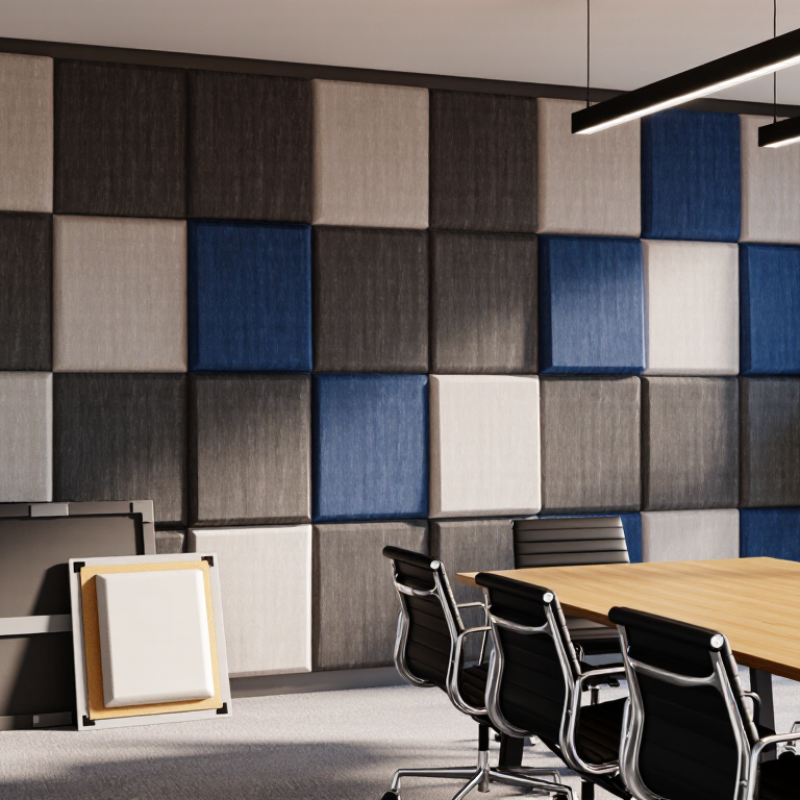
China manufactures several soundproof wall panel types, but their acoustic roles differ. Polyester fiber panels are lightweight, recyclable, and easy to cut around sockets. They mainly absorb mid- and high-frequency reflections. Fabric-wrapped mineral wool panels offer deeper absorption, especially in offices, studios, and meeting rooms. Perforated wood panels combine absorption with a warmer interior appearance. Their rear cavity matters greatly.
Acoustic foam is another common option. Its open-cell structure reduces echo, although it usually performs better at higher frequencies. Composite panels may combine a dense barrier layer, resilient backing, and decorative fabric. These systems can help reduce airborne transmission when installed over sealed wall assemblies. A panel alone rarely makes a thin wall truly soundproof. That distinction is often overlooked.
Grand View Research’s 2023 acoustic panels report valued the global market at about 10.4 billion US dollars in 2022, with continued growth projected through 2030. This demand supports wider Chinese production and more customized panel formats. For evaluation, ask for tested Noise Reduction Coefficient data under ASTM C423 or ISO 354. Remember, NRC measures absorption, not full-wall isolation. In my experience, a high NRC panel can still disappoint beside a poorly sealed door. Installation quality remains the uncomfortable variable.
| Panel Type | Typical Core or Material | Typical Thickness | Primary Acoustic Function | Typical Noise-Frequency Performance | Typical Acoustic Rating or Indicator | Common Applications | Main Advantages | Important Considerations |
|---|---|---|---|---|---|---|---|---|
| Fabric-Wrapped Fiberglass Panel | Rigid fiberglass or glass-mineral fiber board covered with acoustically transparent fabric | 25–100 mm | Broadband sound absorption; reduces reverberation and speech reflections | Effective across mid and high frequencies; thicker panels improve low-frequency absorption | Commonly specified by NRC or equivalent laboratory absorption data; exact values depend on thickness and mounting | Offices, conference rooms, classrooms, studios, cinemas, auditoriums | High absorption efficiency, lightweight construction, many fabric colors and shapes | It primarily controls room echo rather than blocking sound transmission through a wall; fabric and core should be tested for fire performance |
| Mineral Wool Acoustic Panel | Stone wool or mineral wool board with fabric, perforated facing, or decorative finish | 25–100 mm | Broadband sound absorption and improved reverberation control | Good mid- and high-frequency absorption; an air gap behind the panel can improve lower-frequency performance | Absorption is normally reported using NRC, SAA, or frequency-by-frequency coefficients | Industrial buildings, music rooms, public buildings, offices, restaurants | Noncombustible mineral-based core options, strong acoustic performance, durable construction | Product density, facing, edge treatment, and mounting method affect both acoustic and fire results |
| PET Acoustic Panel | Thermally pressed polyethylene terephthalate fiber, often containing recycled content | 6–24 mm | Sound absorption, visual zoning, and decorative acoustic treatment | Most effective in the mid and high-frequency range; thicker or layered designs provide broader absorption | Performance varies widely with thickness, density, pattern, and wall spacing; request tested absorption data | Open-plan offices, schools, meeting rooms, retail interiors, home theaters | Lightweight, easy to cut, available in decorative shapes, generally resistant to moisture and fiber shedding | Thin PET panels alone usually provide limited low-frequency absorption and limited airborne sound isolation |
| Perforated Wood Acoustic Panel | Perforated or slotted MDF, plywood, or wood-based board with an acoustic fleece and mineral or polyester backing | 12–25 mm facing, usually with an absorptive backing | Sound absorption combined with a natural wood or architectural finish | Often tuned for mid-frequency absorption; backing depth and perforation pattern influence performance | Acoustic data should be reviewed by octave or one-third-octave frequency bands, not by appearance alone | Hotels, restaurants, offices, lecture halls, cultural spaces, high-end residential interiors | Decorative appearance, robust surface, good integration with ceilings and feature walls | Wood-based substrates may require specified fire, moisture, and formaldehyde-emission documentation |
| Wood Slat Acoustic Panel | Wood or wood-look slats mounted over acoustic felt, usually with an absorptive backing or cavity | Approximately 20–45 mm, excluding additional wall cavity depth | Sound diffusion and partial absorption; improves room comfort while serving as a feature wall | Performance is strongest in the mid and high frequencies; a deeper cavity can improve absorption | Results depend on slat width, spacing, felt, backing material, and installation gap | Offices, restaurants, studios, residential rooms, hospitality interiors | Attractive linear design, relatively simple installation, combines decoration with acoustic treatment | Open slat spacing should not be confused with a solid sound-isolation barrier; fire performance varies by the complete assembly |
| Acoustic Foam Panel | Open-cell polyurethane or melamine foam with wedge, pyramid, or convoluted surface profiles | 25–100 mm | Sound absorption and reduction of flutter echo and reflections | Generally effective at mid and high frequencies; thin foam has limited low-frequency performance | Use published absorption coefficients measured at specific thicknesses and mounting conditions | Recording rooms, broadcast spaces, equipment rooms, rehearsal rooms, small studios | Lightweight, easy to install, economical, available in multiple profiles | Acoustic foam does not provide substantial wall sound isolation; fire, smoke, aging, and environmental requirements must be checked |
| Micro-Perforated Panel | Micro-perforated plastic, metal, wood, or composite facing with an enclosed air cavity | Facing thickness varies; cavity commonly 50–200 mm | Resonant sound absorption without conventional fibrous infill | Can be engineered for selected frequency bands; performance depends strongly on hole size, perforation ratio, and cavity depth | Frequency-specific laboratory data is essential because performance is design-dependent | Clean rooms, transport interiors, public buildings, architectural feature walls | Low-fiber design, cleanable surfaces, tunable acoustic behavior, modern appearance | Usually more sensitive to design and installation accuracy than standard porous panels |
| Mass-Loaded Vinyl Composite Panel | Flexible high-mass vinyl barrier, sometimes laminated with foam, polyester, or fiberglass layers | Barrier thickness commonly about 1.5–3 mm; composite thickness is greater | Sound transmission reduction when installed as part of a sealed wall, ceiling, or enclosure system | Useful for improving airborne sound isolation across a broad range; low-frequency results depend on the complete wall assembly | Performance is normally evaluated as part of an assembly using STC, Rw, or frequency-specific transmission-loss data | Partition upgrades, equipment enclosures, doors, ceilings, vehicle and machinery applications | High surface mass in a flexible format; can be incorporated into existing construction layers | It is not normally a decorative finish panel; seams, penetrations, flanking paths, and airtightness strongly affect results |
| Composite Soundproof Wall Board | Multi-layer construction combining gypsum or cement board, damping layers, mineral wool, foam, or acoustic felt | Approximately 20–100 mm, depending on the layer arrangement | Combined absorption, damping, and airborne sound isolation | Potentially broader performance than a single porous panel, but results depend on the full wall system | Look for tested assembly values such as STC or Rw together with absorption data where applicable | Residential partitions, offices, hotels, media rooms, machinery rooms | Can address several acoustic mechanisms in one system and may simplify installation | Panel performance cannot be separated from framing, joints, fasteners, wall cavities, doors, and service penetrations |
| Selection note: In acoustic engineering, sound absorption and sound isolation are different objectives. Porous panels such as fiberglass, mineral wool, PET, and foam mainly reduce reverberation inside a room. For blocking sound transmission, a complete tested wall assembly normally requires mass, decoupling, damping, cavity absorption, and airtight detailing. Actual performance should be confirmed through laboratory test reports and project-specific installation details. | ||||||||